
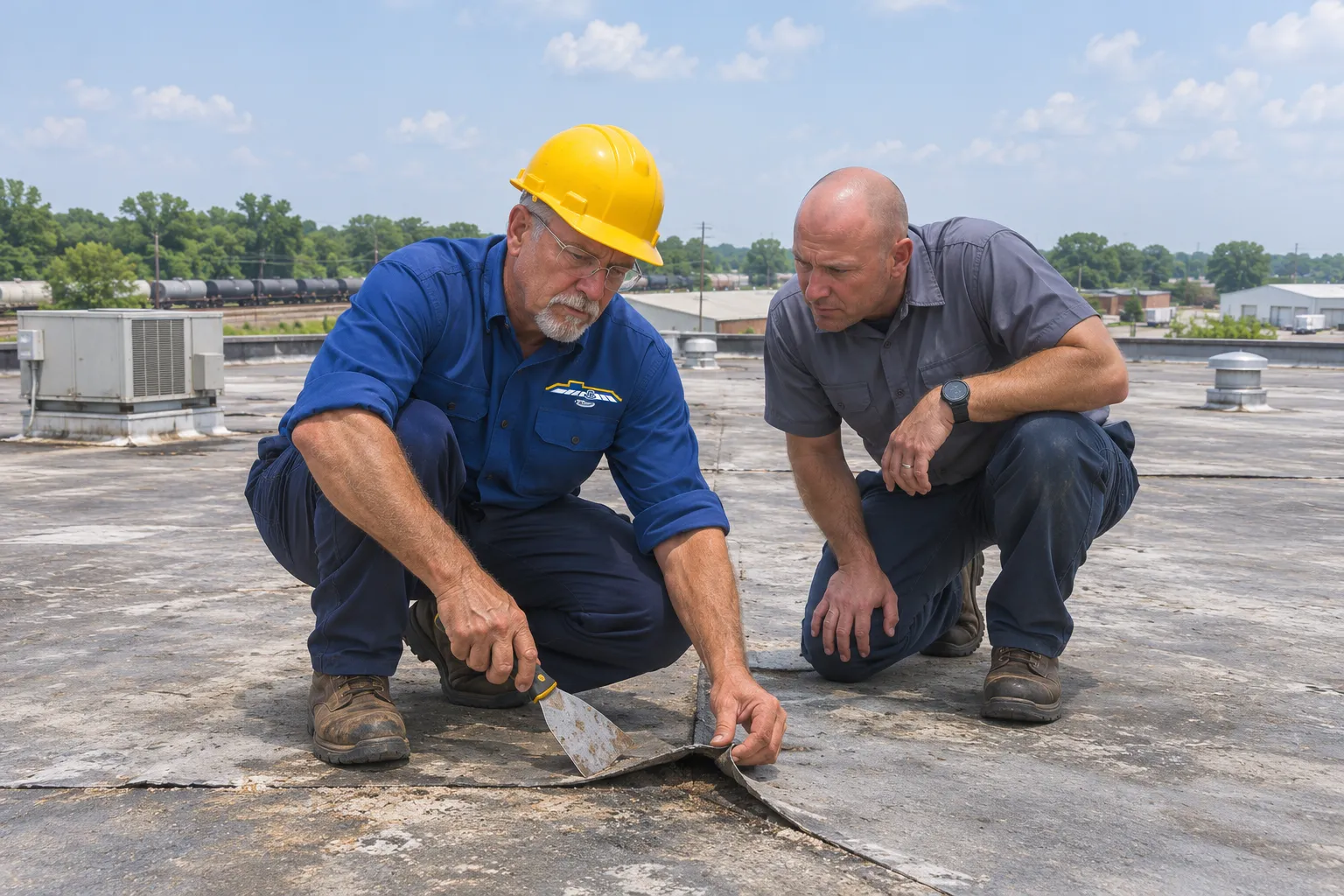
Commercial Roof Repair Questions in Louisville
Get Straight Answers About Leaks, Seams, Permits, and Repair Limits
These commercial roof repair questions in Louisville come from owners and facility managers dealing with leaks, open seams, permits, and storm damage.
Where Leaks, Repairs, and Permits Meet
Below are the commercial roof repair questions in Louisville that owners ask most, grouped by roof type and topic.
Commercial roof repair is the work of tracing and fixing leaks, split seams, loose flashing, and storm damage on existing flat, metal, and industrial roofs so the current system keeps working. Louisville Commercial Roof Repair works on business and industrial roofs across Louisville, Jefferson County, Kentucky, and surrounding towns in Jefferson and Bullitt counties.
- Commercial Roof Repair Basics
- Flat Roof Repair Questions
- Commercial Metal Roof Repair Questions From Louisville Owners
- Commercial Roof Leak Repair Questions for Louisville Buildings
- Industrial Roof Repair Questions
- Weather, Permits and Codes in Louisville
- Cost, Value and Taxes
- Commercial Roof Repair Questions in Louisville by Town
- Getting Started
- Sources
Commercial Roof Repair Basics
What problems does commercial roof repair fix?
Commercial roof repair fixes the specific spots where water gets into a building, such as open seams, punctures, failed flashing, clogged drains, and loose fasteners. The goal is a dry building with the existing roof left in service.
Common repair calls on Louisville buildings:
- Split or lifted membrane seams
- Punctures from dropped tools near HVAC equipment
- Flashing pulled away from parapet walls and curbs
- Backed-out screws and cracked washers on metal panels
- Rusted gutters and leaking downspout outlets
- Blocked drains that leave ponding water
Each repair starts by finding the true entry point, which is often several feet from the ceiling stain.
When does a roof need repair, restoration, or full replacement?
Repair fits a roof with isolated damage, restoration fits a roof that is aging evenly but still dry underneath, and replacement fits a roof with wet insulation or a failing deck across large areas.
| Path | Roof condition | Typical work |
|---|---|---|
| Repair | Local leaks, a few open seams or loose flashings | Patches, new flashing, resealed fasteners |
| Restore | Membrane or panels weathered but mostly dry | Cleaning, seam reinforcement, fluid-applied coating |
| Replace | Wet insulation across wide areas, rusted deck | Tear-off or recover with a new system |
Moisture readings and cores decide which row a roof belongs in. A single building can need repair on one section and replacement on another.
What separates a temporary roof patch from a permanent repair?
A temporary patch slows water during bad weather, while a permanent repair rebuilds the failed detail with materials matched to the roof. Temporary fixes buy time and get replaced once conditions allow.
| Feature | Temporary patch | Permanent repair |
|---|---|---|
| Surface prep | Wipe and dry the area | Clean, prime, and cut back damaged material |
| Materials | Wet-surface mastic, peel-and-stick tape | Matching membrane, flashing, or panel |
| Weather | Applied in rain or cold | Applied in dry, workable temperatures |
| Lifespan | Short, until a dry day | Built to match the surrounding roof |
Mastic smeared over a seam often traps moisture. Marking every temporary patch on a roof plan makes the follow-up visit faster.
Why do commercial roof leaks show up far from the actual hole?
Water travels sideways under membranes, along steel deck flutes, and across purlins before it drips, so the ceiling stain and the roof opening are seldom in the same place. Finding the entry point means working uphill from the drip.
Paths water takes inside a roof:
- Along the flutes of a steel deck toward the low side
- Through wet insulation boards that wick water outward
- Down the face of a parapet wall behind loose flashing
- Following purlins on a metal building to a low spot
Tracing the path on the roof surface usually leads to a seam, curb, or penetration upslope of the stain.
Flat Roof Repair Questions
What causes most flat roof leaks on commercial buildings?
Most flat roof leaks on commercial buildings start at seams, flashings, and drains, where the membrane changes direction or meets another material. Open field areas leak far less often than the edges and penetrations.
Frequent sources on Louisville flat roofs:
- Seam laps that have opened or lost adhesion
- Base flashing peeling off parapet walls
- Curb flashing at HVAC units and exhaust fans
- Drain clamping rings that have loosened
- Punctures along service paths
Ponding near a leak points to a drainage problem feeding it. A clean, dry drain bowl and tight flashing fix more flat roof leaks than patches out in the field.
How is a split seam on a TPO or EPDM flat roof repaired?
Split seams on single-ply flat roofs are repaired by cleaning the area back to fresh membrane, then covering the opening with a matching patch that extends well past the damage. TPO and EPDM need different methods.
- TPO patches are hot-air welded after the aged surface is scrubbed with a membrane cleaner.
- EPDM patches go down with primer and seam tape, then lap sealant along the edges.
Long seam failures get a continuous cover strip instead of many small patches. Probing the neighboring laps shows whether the split is one spot or the start of a wider seam problem.
Should blisters on a flat roof be cut open?
Blisters on a flat roof get cut open and repaired when they are broken, soft, or sitting in a traffic path, while small intact blisters are often marked and watched. Most show up on built-up and modified bitumen roofs, where trapped moisture or air lifts the plies.
Repair steps for a damaged blister:
- Cut an X across the blister and fold back the plies.
- Dry the area and check the insulation under it.
- Reset the plies with compatible adhesive.
- Cover the cut with a patch that overlaps solid membrane.
Many blisters on one roof point to moisture trapped in the system.
How is ponding water on a flat roof fixed?
Ponding water is fixed by improving the path to the drain, through clearing outlets, adjusting drain height, or adding tapered insulation crickets in low areas. Patching the membrane under a pond leaves the low spot in place.
Repair options from simplest to largest:
- Clear strainers and leader pipes at clogged drains
- Lower or re-set a drain that sits high
- Add a cricket that diverts water around a curb
- Cut a new scupper through the parapet
- Install tapered insulation under a new section of membrane
Dirt rings left after a pond dries show its edges. Measuring water depth after rain helps size the fix.
Can a flat roof be repaired in cold or wet weather?
Temporary flat roof repairs can go on in cold or wet weather, while permanent membrane repairs wait for a dry surface and temperatures inside the product's limits. Primers, adhesives, and seam tapes all have minimum application temperatures.
Cold or wet weather options:
- Wet-surface mastic over a split seam
- Peel-and-stick patches on a toweled-dry area
- Tarps weighted at the edges over a damaged section
Any temporary patch gets logged with its location and date. Once a dry window opens, the crew returns, removes the patch, and makes the permanent repair at that seam, drain, or flashing.
Commercial Metal Roof Repair Questions From Louisville Owners
Why do commercial metal roofs leak at the screws?
Commercial metal roofs leak at the screws because panels expand and contract daily, which works fasteners loose and wears out their rubber washers. Overdriven screws crush washers on day one, and underdriven screws never seal.
Repair work on exposed-fastener roofs:
- Remove backed-out screws and replace them with oversized fasteners
- Install new screws with fresh washers seated flat
- Seal stripped holes in panels with patch plates
- Check stitch screws along side laps
Rust streaks under fastener heads show which rows leak first. Replacing a whole row at once often costs less in labor than chasing single screws.
What stops leaks at the end laps and side laps of metal panels?
Leaking end laps and side laps are repaired by removing old sealant, cleaning both panel surfaces, and resealing the joint with butyl tape or reinforced seam fabric. Loose laps also get new stitch screws to pull the panels tight.
A typical lap repair:
- Scrape away failed caulk and mastic.
- Wire-brush rust and clean the metal.
- Install stitch screws to close the gap.
- Embed reinforcing fabric in a compatible sealant over the lap.
End laps on low-slope metal roofs hold water longest, so they deserve the first look on any leak call.
What can be done about rusted panels on a commercial metal roof?
Surface rust on commercial metal panels can be cleaned, primed, and sealed, while panels with rust holes need replacement sections. Checking from inside shows whether purlins under the rusted area also need work.
| Rust level | What it looks like | Repair |
|---|---|---|
| Surface | Orange film, metal still solid | Wire-brush, prime, seal |
| Scale | Flaking layers, thinning metal | Grind, prime, cover with patch panel |
| Perforated | Holes or pinholes, daylight visible | Replace the panel section |
Rust usually starts at low panel ends, gutters, and under debris piles. Clearing leaves and dirt from those areas slows the next round of corrosion.
How are leaks around curbs and skylights fixed on a metal roof?
Leaks at HVAC curbs and skylights on metal roofs are fixed by rebuilding the flashing and adding a diverter on the uphill side, so water moves around the opening. Many original curbs on metal buildings were sealed with caulk alone.
Common fixes:
- Install a cricket or diverter above the curb
- Replace cracked translucent skylight panels with matching profiles
- Reseal skylight laps with butyl tape and new fasteners
- Rebuild curb flashing with metal that matches the panel ribs
Skylight panels yellow and crack with age. Matching the rib profile exactly keeps the laps tight against the neighboring steel panels.
Do gutters and ridge caps cause leaks on commercial metal roofs?
Gutters and ridge caps cause many commercial metal roof leaks, especially box gutters with open seams and ridge caps with torn foam closures. Water that backs up in a gutter can run under panel ends into the wall.
Points to check:
- Box gutter seams and soldered or sealed joints
- Gutter outlets and downspout connections
- Foam closures under ridge caps
- Fasteners along ridge cap edges
Wind-driven rain gets past missing closures easily. Replacing closures and resealing the cap laps solves many leaks that show up only during storms.
Commercial Roof Leak Repair Questions for Louisville Buildings
How does a roofer find the source of a commercial roof leak?
A roofer finds a commercial roof leak by matching the inside drip location to the roof above, then checking every seam, curb, and penetration upslope of that point. Leak logs and weather notes speed up the search.
Tools used during leak tracing:
- Interior photos and measurements tied to roof landmarks
- Moisture meters on the roof surface
- Infrared scans at dusk to find wet insulation
- Controlled water testing on suspect details
Testing one detail at a time isolates the source. Running water on a curb for a set period while someone watches inside confirms or rules out that spot.
Which roof parts leak most often on each type of commercial roof?
Leak sources follow the roof system, so a TPO roof, an EPDM roof, and a metal roof each fail at different details.
| Roof type | Frequent leak sources |
|---|---|
| TPO | Cold welds at seams, T-joints, curb corners |
| EPDM | Lifted seam tape, shrinkage at parapets, pipe boots |
| Modified bitumen | Blistered laps, cracked flashing at walls |
| Built-up | Splits over insulation joints, dried pitch pans |
| Metal R-panel | Fasteners, end laps, ridge closures |
| Standing seam | Seam caps, curb flashings, gutter joints |
Knowing the system narrows the search before the first test. Older buildings with additions can carry three of these systems on one roof.
What should a facility manager do when a roof starts leaking?
Protect what sits under the leak, record when and where it appears, and keep people off the roof during storms. Those notes help the repair crew trace the source quickly.
Immediate steps:
- Move product and equipment out from under the drip
- Set buckets and plastic sheeting
- Photograph the stain and the ceiling area around it
- Write down the time, rain intensity, and wind direction
- Check whether drains are visible and flowing, from a safe spot
Clearing a clogged drain sometimes ends a leak right away, but only when roof access is safe.
Can a pitch pan cause a roof leak?
Pitch pans cause many roof leaks on older commercial roofs because the filler inside shrinks and cracks, opening a path down the support or pipe. They hold sealant around odd-shaped penetrations such as sign posts and equipment supports.
Repair choices:
- Refill a shallow pan with pourable sealer after cleaning
- Replace the pan with a taller one when filler sits low
- Swap the penetration for a curb or pipe boot when possible
Pans dry out faster in summer sun. Checking them twice a year, especially after hot weather, catches gaps before water gets in.
Why does a commercial roof leak only during wind-driven rain?
Leaks that appear only with wind-driven rain usually come from vertical surfaces, such as parapet walls, coping joints, and counterflashing, where wind pushes water sideways. The roof membrane itself often stays dry.
Places to check:
- Open joints in parapet coping caps
- Cracked mortar or masonry above the roof line
- Counterflashing pulled out of its reglet
- Missing foam closures at metal panel ridges
Notes on wind direction during each leak narrow the search to one side of the building. Water testing that side of the parapet confirms the entry point.
Industrial Roof Repair Questions
How are repairs handled on an industrial roof over active operations?
Industrial roof repairs over active operations follow the plant's safety rules, including hot work permits, lockout of nearby equipment, and work zones agreed with plant staff. Repairs get scheduled around production and deliveries.
Planning items:
- Hot work permits for heat welders or torches
- Fall protection near skylights and roof edges
- Exhaust fans shut down near the work area
- Material lifted by hoist or crane at set times
Plant staff mark the areas inside that need protection before crews open a roof section. Each opening gets sealed before the crew leaves for the day.
Which roof damage comes from exhaust fans and process vents on a plant?
Exhaust fans and process vents can soften, swell, or stain membranes when grease, oil, or chemicals settle on the roof. The damage usually forms a ring around each discharge point.
Signs of exhaust damage:
- Spongy or swollen membrane near fans
- Dark staining spreading from vent curbs
- Cracked flashing at the fan curb base
Repairs use membrane suited to the discharge, such as a grease-resistant sheet around kitchen or process exhaust. Containment boxes catch grease before it reaches the roof surface.
How do membrane repairs compare with metal roof repairs on an industrial building?
Membrane repairs rebuild the waterproof sheet with matching material, while metal roof repairs reseal joints and fasteners or replace panel sections. Many plants have both systems on different buildings.
| Repair task | Membrane roof | Metal roof |
|---|---|---|
| Opening | Patch welded or taped over the hole | Patch plate or new panel section |
| Joint failure | Cover strip over the seam | Butyl tape and stitch screws at the lap |
| Penetration leak | New boot or curb flashing | Diverter and new curb flashing |
| Edge damage | New edge metal and membrane flashing | New trim and closures |
Matching materials keeps the repair compatible with the surrounding roof.
How are punctures from foot traffic and dropped tools repaired on large roofs?
Punctures on large industrial roofs get cleaned, dried, and covered with patches of matching membrane, and the insulation under each hole gets checked for moisture. Service paths around equipment collect the most damage.
Ways to reduce repeat punctures:
- Lay walk pads to every HVAC unit and exhaust fan
- Set tool trays near equipment that gets frequent service
- Mark paths with high-visibility pads
- Ask service companies to report any dropped parts
Screws, washers, and sheet metal scraps left on a roof get stepped into the membrane. Sweeping service areas after each equipment visit removes them.
When is an industrial roof too far gone for repairs?
An industrial roof is too far gone for repairs when wet insulation spreads across large areas or the deck has corroded through. Patching at that point keeps chasing leaks that come back.
Signs that repair alone has reached its limit:
- Infrared scans showing wide wet areas
- Steel deck rust visible from inside in several bays
- Leaks recurring at new locations each month
- Membrane shrinking and splitting at many seams
Sections in better condition can still be repaired while worse areas get replaced. That split approach keeps the plant running and spreads out the work.
Question About Your Own Roof?
Water Coming In
Call us with where the drip shows up and when it started, and we will talk through the first step.
Call UsReady for an Inspection
Send the address and a note about the roof system, and we will set up a free inspection.
Schedule Your Free InspectionWeather, Permits and Codes in Louisville
What should Louisville building owners check on the roof after a hailstorm?
After hail in Louisville, owners should look for bruised or cracked membrane, dented metal panels, and broken skylights and vent caps, since hail damage often stays hidden until the next rain finds it.
Hail damage often shows up as:
- Soft, bruised spots on modified bitumen or built-up roofs
- Dents with cracked paint on metal panels
- Cracked translucent skylight panels
- Split vent caps and dented HVAC fins
- Granules washed into gutters and downspouts
Photos taken soon after the storm help with insurance claims. Walk the roof only when it is safe and dry, and mark each damaged spot with chalk for the repair crew.
How does Louisville rain and snow affect roof leaks?
Louisville gets frequent rain and some snow, so leaks show up through all seasons. Each year Louisville averages about 48.3 inches of rain and melted snow, plus 13.4 inches of snowfall, per the National Weather Service's 1991 to 2020 normals.
How weather affects leaks:
- Steady rain tests seams and flashings over many hours
- Heavy downpours overwhelm small drains and scuppers
- Snow melting near warm walls refreezes at drains
- Freeze and thaw cycles open small cracks in flashing
Leaks that start after a thaw often trace to ice-blocked drains or gutters. Keeping drains clear before winter helps.
Does a commercial roof repair need a permit in Louisville?
A Louisville Metro building permit covers work to erect, alter, repair, remove, or convert a building, so the size of a roof repair matters when deciding whether to apply. Metro's Construction Review publishes a reroofing guide outlining permit requirements and inspection steps.
| Location | Local step | Who issues the building permit |
|---|---|---|
| Louisville, Okolona, Valley Station | Metro address check | Louisville Metro IPL |
| St. Matthews | Letter of Compliance and business licenses | Louisville Metro IPL |
| Shively | Compliance Certificate | Louisville Metro IPL |
| Lyndon | Plan registration with the City Clerk | Confirm with the City Clerk |
| Watterson Park | Call to City Hall | Confirm with City Hall |
| Prospect | City permit desk at City Hall | Prospect Permits and Code Enforcement |
| Shepherdsville | Building resources page | City of Shepherdsville |
| Hillview | City hall sign-off | Bullitt County inspector |
Ask the office about your specific repair before work starts.
Do floodplain rules apply to roof repairs on Louisville buildings?
Floodplain rules can apply to roof repairs in Louisville, because both MSD and the Kentucky Division of Water require permits to repair buildings in a floodplain. MSD asks whether repair costs exceed 50 percent of the structure's market value.
Market value excludes land and comes from a certified appraisal or the Jefferson County Property Valuation Administrator's assessment. For roof work, that test matters when:
- Repairs follow major storm damage
- The roof job is part of a larger renovation
- Roof costs combine with interior repairs
Ask MSD's floodplain staff early if the building sits near a stream or river.
Cost, Value and Taxes
What affects the cost of a commercial roof repair?
Roof access, the time needed to trace the leak, and the amount of damaged material affect commercial roof repair costs most. Small repairs on easy-to-reach roofs cost less than complex work on tall buildings.
Cost factors:
- Building height and need for a lift or crane
- Roof system and availability of matching material
- Hours spent tracing leaks across multiple sections
- Amount of wet insulation that needs removal
- Number of curbs, drains, and skylights involved
- Work around operations or after hours
Bundling several small repairs into one visit keeps travel and setup costs down.
When do repeated repairs cost more than a restoration or new roof?
Repeated repairs cost more than a larger fix when leaks keep coming back in new spots and wet insulation keeps spreading. Tracking repair costs over time shows the pattern clearly.
Points to compare:
- Repair spending over the last few years
- Area of wet insulation found by scans
- Number of separate leak locations
- Condition of seams across the whole roof
A roof with dry insulation and scattered problems is often a good fit for restoration. Wide wet areas lean toward replacement on those sections.
Can roof repairs be deducted, or do they fall under Section 179?
Routine roof repairs and Section 179 improvements are treated differently for taxes, so ask a CPA how each repair invoice should be classified. Under IRS Publication 946, a roof on an existing nonresidential building counts as qualified real property, which makes it eligible for Section 179.
The 2026 Section 179 cap is $2,560,000, and it starts to phase out once qualifying purchases go past $4,090,000. A patch on one seam and a full section of new membrane and insulation are likely to be classified differently. Clear invoices showing each task help the CPA sort them.
Commercial Roof Repair Questions in Louisville by Town
How should roof drains and downspouts be handled during repairs in Louisville?
Repairs in Louisville leave roof drains and downspouts discharging where they already do, and any move gets cleared first with the Metropolitan Sewer District (MSD), which runs sewer and stormwater service across Louisville Metro.
Repair work often turns up:
- Downspouts disconnected at grade
- Rusted-through gutter outlets
- Cracked drain leaders inside the building
- Debris-choked scuppers in parapet walls
Repair each connection where it sits. Talk with MSD before sending roof water to a new spot on the property, since a new outlet changes where stormwater lands.
Where do Louisville owners find official storm information for a roof damage claim?
Insurers usually want the date and type of storm behind a roof claim, and the National Weather Service forecast office in Louisville posts warnings and storm reports for Jefferson County. Matching roof damage to a recorded storm supports the claim.
Records to gather:
- Date and time of the storm
- Photos of damaged edge metal, coping, or panels
- Interior photos of new leaks
- Notes on hail size or wind seen on site
File repair invoices with the storm records. Adjusters often ask for both together.
Does every trade on a St. Matthews roof repair need a city business license?
Yes. Every contractor and subcontractor listed on a St. Matthews Letter of Compliance application needs a current city business license, and roof repairs often pull in other trades.
Trades that can appear on the application:
- Sheet metal fabricators replacing gutters or coping
- HVAC technicians lifting a unit off a leaking curb
- Electricians relocating conduit across damaged membrane
Gather licenses before filing, because one missing license holds the letter, and the Metro permit after it. Settle the trade list when the repair scope is set, so the paperwork matches the work on the roof.
What do repairs on older Shively industrial roofs usually uncover?
Shively's older industrial roofs usually turn up generations of patches, abandoned curbs, and roof systems that change from one addition to the next once repairs begin. Shively dates to 1938, and its listed points of interest include the Stitzel-Weller and Michter's distilleries.
Common findings:
- Thick tar over base flashing and screw heads
- Roof systems that change at each addition
- Rust at roof-to-wall flashing
- Vent stacks sitting in dried pitch pans
Shively Code Enforcement names debris as a frequent violation, so torn-off patch material belongs in a covered container right away.
Does a roof repair in Lyndon need city registration?
Lyndon's city code calls for plan registration with the City Clerk 30 days or more before work begins, so ask the clerk whether a given repair scope triggers it. Larger repairs that replace whole roof sections are the likeliest to need it.
Details to share with the clerk:
- Roof area involved in the repair
- Type of work, such as seam repair or flashing replacement
- Insulation or deck replacement, if any
A leak that appears during a storm needs a fast fix, so settle the rule with the clerk ahead of time.
Which roof penetrations leak on older Okolona commercial buildings?
On older Okolona commercial buildings along Preston Highway, the penetrations added over decades, such as sign brackets, dish mounts, and conduit, cause many of the leaks. Okolona permits go through Louisville Metro IPL, since it is a Louisville Metro community.
Penetrations to check:
- Sign brackets anchored through the deck
- Dish and antenna bases
- Conduit clamps screwed to ribs or membrane
- Exhaust fans left on unused curbs
Abandoned mounts get removed and their holes patched, while active ones get new flashing or pitch pans.
What roof repairs come up on Watterson Park warehouses?
Warehouse roofs in Watterson Park mostly need repairs at translucent skylight panels, long rows of exposed fasteners, and gutters that empty onto truck courts. As a home-rule city in Jefferson County, Watterson Park has its own City Hall to contact before larger repairs.
Typical repair points:
- Cracked or yellowed skylight panels
- Loose screws along panel side laps
- Downspouts discharging across pavement
- Flashing where dock canopies meet the wall
Fastener rows get checked panel by panel, since one loose screw can drip onto stored goods far from the opening.
After high winds, what should Valley Station building owners inspect first?
Roof edges come first after high winds in Valley Station, so owners along Dixie Highway should look at edge metal, coping caps, and gutter straps. Warnings for this Louisville Metro community come from the National Weather Service forecast office in Louisville.
Wind damage to look for:
- Edge metal lifted at corners
- Coping caps shifted or gone
- Gutter straps torn from the fascia
- Perimeter membrane flapping
Each loose piece of edge metal gives the next storm a handle to peel more membrane, so refastening it soon limits the damage.
Where do Prospect owners get approval for commercial roof repairs?
Commercial roof repairs in Prospect go through the city's Permits and Code Enforcement Department, located at City Hall. Because Prospect spans northern Jefferson County and part of Oldham County, according to the Kentucky Atlas and Gazetteer, check which county a parcel sits in.
Repair details to share with the city:
- Roof area and system type
- Leak locations and planned fixes
- Any flashing, curb, or drain replacement
Parcels on the Oldham County side can involve county offices too, so ask the city which ones apply.
Why does roof drainage need extra care near the Salt River in Shepherdsville?
Low-lying Shepherdsville sites near the Salt River need gutters and downspouts that move roof water well clear of the building, since soggy ground there drains slowly after storms. Undersized gutters and short downspouts make it worse.
Repair points:
- Gutter sizes matched to roof area
- Downspout extensions aimed away from footings
- Scupper and drain outlets kept open
- Seams and end caps resealed on gutters
Site drainage and floodplain questions go to the City of Shepherdsville, whose building resources page lists permit contacts for this Bullitt County city.
What do older Hillview commercial buildings need before roof repairs?
Older Hillview commercial buildings need earlier fixes stripped before repairs start, such as roofing cement globbed on fasteners, off-profile replacement panels, and dried caulk at laps, since new sealant bonds only to clean metal.
Prep work:
- Scraping cement from screw heads
- Swapping panels that mismatch the rib profile
- Cleaning laps down to bare, dry metal
Permits for this northern Bullitt County city start at Hillview city hall, with the Bullitt County building inspector after it. Check that the address falls inside city limits, since neighboring Louisville Metro follows its own process.
What other towns near Louisville are served?
The repair service area also reaches these smaller communities around Louisville.
| Town | County | Local status |
|---|---|---|
| Pleasure Ridge Park | Jefferson | Louisville Metro neighborhood |
| Indian Hills | Jefferson | City with its own permit list |
| Fairdale | Jefferson | Louisville Metro neighborhood |
| Brooks | Bullitt | Unincorporated community |
| Pioneer Village | Bullitt | Home rule city |
| Hebron Estates | Bullitt | Home rule city |
Each status affects which office handles permits, so confirm the parcel before planning larger repairs.
Getting Started
What helps a roofer fix a commercial leak faster?
A leak log with dates, locations, and weather notes helps a roofer fix a commercial leak faster, because it points straight to the likely seams, flashings, or fasteners. Noting whether drips show up in any rain or only in wind from one direction helps narrow it.
Helpful information:
- Interior photos of each leak
- Roof age and system type
- Past repair invoices
- Access details for the roof hatch or ladder
- HVAC companies that service the roof
What happens during a commercial roof repair visit?
Each repair visit starts with a walk of the roof and the interior leak areas, then focuses on the seams, flashings, drains, and fasteners above each leak. The crew documents what they find with photos.
During the visit:
- Inspect the suspected entry points
- Test details with water if needed
- Make temporary or permanent repairs
- Note other problems seen on the roof
Louisville Commercial Roof Repair then explains what was fixed and what conditions to watch for next.
Sources
- National Weather Service Louisville, Monthly, Seasonal and Annual Normals 1991 to 2020
- Louisville Metro Construction Review, Building Permit
- Louisville Metro Construction Review, Guide to Reroofing Project
- Louisville MSD, Flood Permitting
- IRS Publication 946, How To Depreciate Property
- City of St. Matthews, Building Permit
- City of Shively, Points of Interest
- City of Shively, Code Enforcement
- City of Shively, Compliance Certificate
- City of Lyndon Code of Ordinances, Building Plans and Registration
- City of Watterson Park, Meeting Minutes June 2026
- City of Prospect, Permits and Code Enforcement
- Kentucky Atlas and Gazetteer, Prospect
- City of Shepherdsville, Building Resources
- Kentucky Department of Housing, Buildings and Construction, Bullitt County Inspectors
- City of Indian Hills, Permits Required by Ordinance
Still Have Commercial Roof Repair Questions in Louisville?
Tell us about the roof and the leak. We will answer what we can by phone and set up a free inspection for the rest.